
The MAGA movement’s wholesale attack on democratic institutions has not spared colleges and universities. Using the pretext of rampant anti-Semitism on campuses in the wake of Israel’s attack on Gaza, Trump’s Departments of Justice and Education have made decisive moves to curtail academic freedom. To date, his administration has imposed steep financial penalties on Columbia, Harvard, and Brown (among many others) and reduced or removed federal funding for grants and research in scores of schools nationwide. Research in higher education has wider benefits for society at large and the loss of many programs will negatively affect all Americans in the future. Government support for higher education in disciplines such as medicine, engineering, and biotechnology has created an economy of innovation that has changed lives worldwide. It is this sustained support that helped make American universities among the most distinguished in the world.
Many institutions were already considering austerity measures in response to shifting demographics and financial pressures, but the administration’s abrupt and punitive tactics forced immediate and drastic decisions. Harvard moved to cut PhD positions in the Faculty of Arts & Sciences by half over the next two admissions cycles. When Princeton president Christopher Eisgruber publicly criticized Trump in an editorial, the administration responded in kind by cutting $210,000,000 in federal support, forcing the school to shutter some winter classes, pause capital investment projects, and put faculty hiring on hiatus. The University of Maine was forced to implement budget cuts that reduced financial aid to graduate students and laid off staff after the governor refused to ban transgender girls from female athletics. These are just a few of many examples.
In most cases, schools are held ransom until they comply with certain (and oft-changing) demands. Generally, these include reducing Diversity, Equity, and Inclusivity (DEI) efforts on campuses, addressing anti-Semitic sentiments in the student body and faculty, and hiring more conservative professors and staff to encourage “viewpoint diversity.” Many universities across the country have already taken steps to meet the first demand. Harvard restructured and rebranded its Office of Diversity, Equity, Inclusion, and Belonging as a new office of “Campus and Community Life.” Brown agreed to adhere to the principle that there are only two genders, and Columbia altered or removed references to “DEI” from most of its public-facing materials. It was a mournful thing to witness a mass accession to Trump’s demands and with such alacrity. Universities, of course, need funding to continue their mission to educate and conduct research. I’m sure many of the concessions made were done so grudgingly and by pragmatic minds. Still, to see so many institutions abandon the bedrock principles they had championed for years was a startling thing.
On the issue of addressing anti-Semitism, the response from higher education began with a round of presidential resignations at Harvard, Columbia, and UPenn, where leadership was under fire for their handling of the Israel/Gaza anti-war protests. Implications were made that the administrations allowed anti-Semitism to flourish on campus. Meaningful changes for Jewish students were scant, but repercussions for Muslim students came swiftly. Protestors like Leqaa Kordia and Mahmoud Khalil at Columbia and Rümeysa Öztürk at Tufts University, were arrested and threatened with deportation. Labeling pro-Palestinian protestors “terrorists,” Trump wrote at the time: “This is the first arrest of many to come…We expect every one of America’s Colleges and Universities to comply.” Many international students had their visas revoked or faced deportation for their activism on campus. A record 21 bills censoring speech on campus or imposing “gag orders” on certain academic subjects passed in 15 states nationwide. “Politicians are expanding a sweeping web of political and ideological control over higher education in American campuses, reshaping what can be taught, researched, and debated to fit their own agenda,” wrote Amy Reid of PEN America. That’s dangerous for free thought in a democracy.”
Facing an onslaught of government reprisals and a crackdown on speech, campuses once enlivened by the spirit of free inquiry became reticent places. Professors report taking care to mind what they teach and say in the classroom out of fear that it will cost them their jobs. Others are resigning and fleeing to teach abroad. Student protests that seemed omnipresent two years ago have disappeared – in fact, young people of college age are notably absent from anti-ICE protests sponsored by the “No Kings” movement. The reasons are likely complicated, but institutional complicity, legal risk, and political pressure have almost certainly played a role.
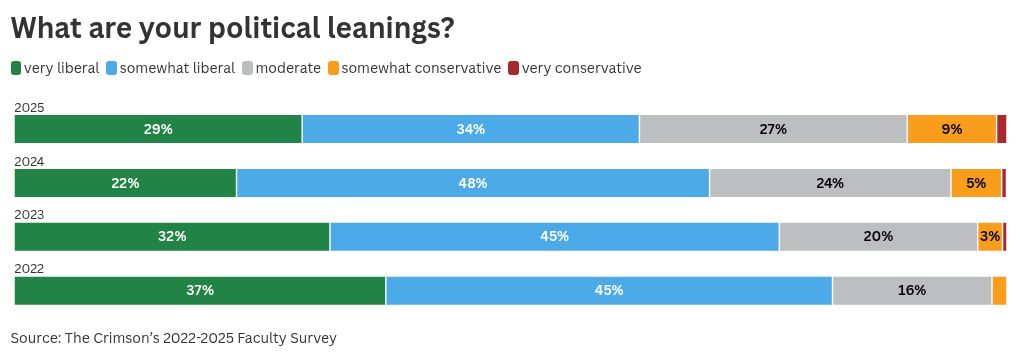
How prevalent anti-Semitism is on American college campuses is up for discussion, but it’s long been the bray of the right that universities are bastions of liberal thought. That claim, in this context, begins to look less like a critique and more like a rationale. Last year, for example, Harvard faculty were surveyed on their political views and the majority – unsurprisingly – lean left. (See figure below.) To ask why educational attainment and liberalism are intertwined opens up a very complex intersectional analysis of socioeconomics and class, epistemological methodology, and behavioral theory. A simpler explanation may suffice here: people trained to question assumptions and engage with complexity are less likely to defer to authority or abide rigid orthodoxy.

This brings some clarity to the current administration’s demands that universities hire more conservative faculty. A mix of balanced perspectives will go some way, the argument from the right goes, toward addressing the “indoctrination” of American’s youth into liberal politics. But what the right fears are critical thinkers and nonconformists. It holds bare contempt for a world of many skin colors, religious traditions, and ideological perspectives. The war on higher education is an attack on those who would conceivably resist the imposition of a new hegemony in thought and action.
Viewpoint diversity has many benefits for education: it encourages rigorous and thoughtful debate, it makes it incumbent upon students to clearly rationalize and articulate their perspectives, and it offers the opportunity to synthesize disparate thought processes into innovative ideas. The administration’s actions suggest a different agenda: not the expansion of discourse, but the stifling of ideas it finds inimical to its tyrannical aims. (As aforementioned, ideas that promote greater inclusivity and equity, for one.) Bringing in conservative faculty whose purpose is to suppress and not promote discourse raises another question of how viewpoint diversity will be handled on beholden to the right? On settled scientific issues, for example, in biology and climate change: will it now be necessary to have a creationist present in the evolutionary biology department? And what of moral dilemmas – should a discourse on human rights include someone who denies them? A look at this administration’s actions to date portends the worse, as even issues long considered axiomatic (for example, the constitutional principle of the equal value of all individuals) are flaunted or trampled away by masked extrajudicial goons. If anything, Trump and his cabinet have acted as if they only adhere to one moral, Orwellian principle: some animals are more equal than others.
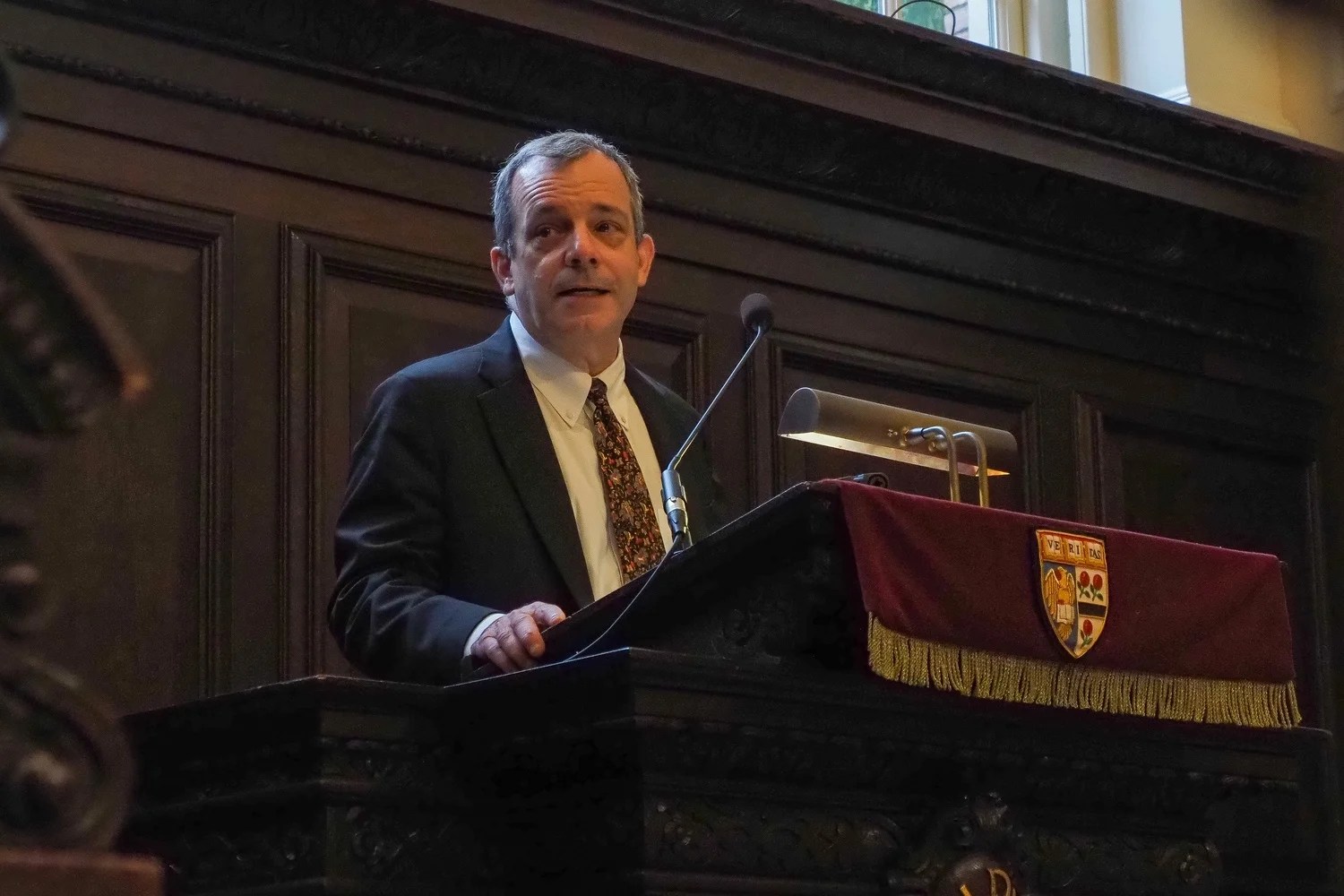
Today, The Crimson reported that, for the past year, Harvard Provost John Manning (’82) has been leading a fundraising campaign to install conservative professors in departments across the campus. Although the idea of hiring more conservative faculty has been on the table for some time, it was thought that the faculty would be siloed in a singular hub – a new institute or center, for example. Today’s revelation is alarming because it embeds conservative viewpoints within departments themselves. Much depends on what types of conservative professors the school chooses to hire, but worst-case scenarios like the creationist in a life sciences department do come to mind. If these faculty arrive with a prescribed agenda from the administration, the quality of discourse on campus is sure to degrade. We have seen that agenda, and what it means for scientific progress and the quality of human life in the future.
Already Harvard has seen the insidious creep of MAGA influence on its conservative complement of students; as also reported this week, the Harvard Republican Club attacked the Islamic Society’s eid al-fitr celebration in Quincy Yard in a disingenuous and racist Tweet, saying the campus had been “captured” by Muslims. (Of note, the event was open only to students, faculty, and alumnae.) This follows last year’s news that students working for the campus conservative magazine Salient used racial slurs and praised Hitler in Signal chats obtained by The Crimson staff. Similar incidents have happened elsewhere; high school students in Redwood California spelled out a slur on their shirts, targeting a queer peer, Florida International University College republicans engaged in a text chat celebrating lynching, Salisbury University republicans attempted to hold a “white advocacy” event.
If this is the brand of conservativism Manning intends to ensconce in academic departments, Harvard is destined for dark times. And, as a bellwether for the rest of the nation’s colleges and universities, Harvard’s craven submission to Trump bodes ill for the academy as a whole. Will other universities seek to hire more conservative faculty behind the front of “viewpoint diversity” and further curtail free speech and inquiry in America’s schools? Will academic forums become venues for relitigating settled questions of science and human rights? And what will be the long-term cost of diminished investment in research across critical fields?
A university that acts out of fear, subverting its mission to pursue truth, is no longer a university—it is an instrument. And once that line is crossed, it is not easily redrawn. If academic inquiry must first pass a political litmus test, then it is no longer free inquiry at all. The slow erosion of academic freedom has begun, and unless universities choose resistance even to the peril of their budgets, it’s only a matter of time before they no longer foster inquiry, only obedience.


Leave a Reply