
Sincerest apologies for the cheeky title of this article – I am bone tired, and in need of caffeine. How ill-opportune a time to undertake a heady exercise such as this: today I will consider the dramatic tension at the close of Johann Goethe’s Faust and its musical setting in Gustav Mahler’s 8th Symphony (colloquially called “The Symphony of a Thousand,” due to the massive number of players needed to perform it). Faust presents us with quite a few dualities: experience contra knowledge, classical contra modernist thinking, beauty contra suffering to name a few. The question I want to answer here: does Mahler resolve these opposing forces? That is to say, is the symphony’s second act a fair reflection of the final scene in Faust?
Let us dispense immediately the objection that contrasting two art forms is “apples to oranges” work – yes, that’s a given, especially as music is a more fluid medium with fewer “structures” upon which to make categorical conclusions. Words provide explicit meaning, though in Faust‘s case that’s far less so. The books is highly allegorical and Goethe uses fantasy, dreams, mythical creatures, and songs as his instrumentation, thus many of the themes are open to interpretation. Moreover, Faust doesn’t deal in certitude, and that point is key as we proceed. Regarding musical notation, we can draw conclusions about the emotional intent of a piece based on aspects of the score (chord structure, tempo, melodies, arrangements, and so on). It’s from this base I will consider Mahler’s 8th.
Beware – there are spoilers for the book if you haven’t read it.
A Mountain Gorge (Final Act of Faust)
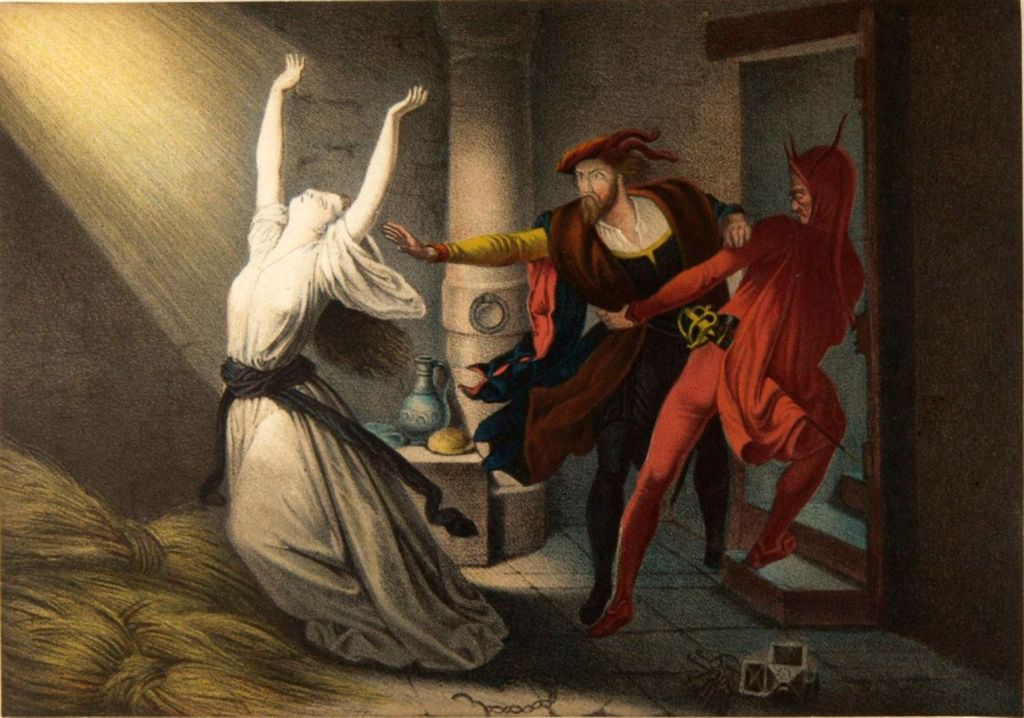
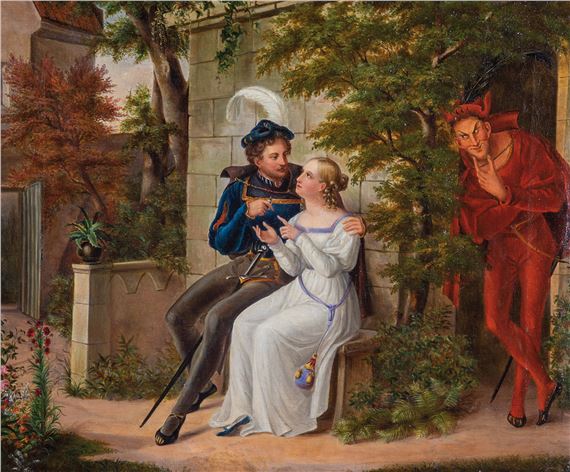
We begin with the book. Immediately proceeding the final scene in the mountains, the devil Mephistopheles is “defeated” by an army of angels. His character is the embodiment of the things Goethe wants to question and critique: he is a man of reason, grounded in the real and experienced, his currency is irony and wit, and he is thoroughly reductionist in his thinking. He’s the puppet master who drives Faust’s story and the events of the play to this point – arranging the love affair with ill-fated Gretchen, transporting Faust to two versions of Walpurgisnacht (a German festival with elements of May Day); first a medieval setting with witches and goblins, and in Book 2 a classical version comprised of Greek figures like the Gorgons, sphinx, and dryads. Book 1 mostly presents Mephistopheles’ worldview, emphasizing the real over abstractions, while Book 2 uses elements of classicism to elevate transcendence and imagination. This separation of the story aids in Goethe’s goal of setting up a tension between experience and pure knowledge. He asks: what is the end point of struggle, is it arrive at a point of certainty, or to experience ongoing transcendence?
Mephistopheles isn’t vanquished in the truest sense, but rather and crucially he discovers that his worldview has been rendered impotent. Faust’s story and the action of narrative are moving out of his frame of reference; no longer will he control events, and his reductionist thinking is redundant in the world that’s taking shape. The story is moving upwards, toward a higher realm in which he has no place.
The final act begins in a mountain gorge. Here the forces are emergent and sublime, not readily comprehensible to the negation and deconstruction of a strictly “reasonable” mind. The reader is potentially set up for a final resolution of the conflicts that have proceeded, and perhaps eager to learn “what is the final end of our struggling?” We witness various figures, mostly symbolic, at various levels of elevation along the sides of the cliffs. The natural scene underscores earthly beauty; forests, caves, and waterfalls present an idyllic scene. Along the bottom to middle of the gorge are hermits, three of whom are named and each one representing various levels of spiritual existence, from extremes of raptured ecstasy (Pater Ecstaticus) to sober stoicism (Pater Profundis) and a middle ground between the two (Pater Seraphicus). The landscape points upward intentionally, here and for the first time in the story all things are moving toward the heavens. There, at that highest level, angels hover and arrange the firmament. Below is a chorus of “penitent women,” among them Faust’s lover Gretchen – abandoned and executed for murder in Book 1. They sing of ascension and intercede between heaven and earth. Three are named specifically, the Magna Peccatrix (mother of sins, traditionally interpreted to be Mary Magdalene), Mulier Samaritana (Samaritan woman), and the Maria Aegyptiaca (Egyptian woman, at the well). Each functions as a feminine counterpart to the Paters.
Faust himself is notably passive – present but merely a moving part, here being summoned to glory by the upward force of the angels and the Mater Gloriosa, “the define feminine.” It’s rather remarkable that Goethe offers this model of the divine, but it works especially well since Mephistopheles and the “modern” world enforce domination, control, and deconstruction. This divine feminine is an ideal of the opposite: wholeness, integration, wonder and admiration for things that cannot be explained. Grace and the love of beauty and connection with others are also idealized. It was a subversive move by Goethe, who no doubt wanted to challenge the bourgeois morality of his contemporaries. Theatregoers in 1808 would have been appalled, for example, to see Gretchen redeemed here in this final act, considering she was convicted of murdering her baby and having had sex out of marriage. As scholar Carol Diethe writes, “she is not just a fallen woman but a felon, which is precisely why Goethe places her in the redemptive role, forcing his wealthy Weimar theater audience to show tolerance, willy-nilly.”1
A mystical chorus sings us away and closes the book:
All that is transitory
Is but a symbol;
The insufficient
Here becomes fulfillment;
The indescribable
Here is accomplished;
The Eternal Feminine
Draws us upward. (Standard English Translation)
The choice of words is important. Throughout the book, Goethe offers hints about his greater thesis – that there isn’t a destination, and shouldn’t be – that the struggling itself is the point. In the early part of Book 1, Act 1, Faust implies that by seeking to preserve a static state – beauty that never changes – one only achieves death. Without movement and change there is only stagnation. (Perhaps the most effective line to this effect is in Act V: “Only he deserves freedom and life who must win them daily.”) Thus, when the Chorus Mysticus sings that “the insufficient becomes fulfillment,” imperfection is painted as itself the source of contentment. The “indescribable” is extolled rather than that which can be quantified and reduced. And, the final line does not suggest an arrival, but a constant attracting force. We are drawn but not placed.
Altogether observed, what Goethe leaves us with is not a destination or a concrete resolution. It’s rather an invitation to keep moving forward and upward, compelled by wonder and beauty, yet aware that it will be a struggle, and the struggle itself is the essence of being human. If we choose not to keep striving, we choose death.
Das Ewig-Weibliche (2nd Movement of 8th Symphony)
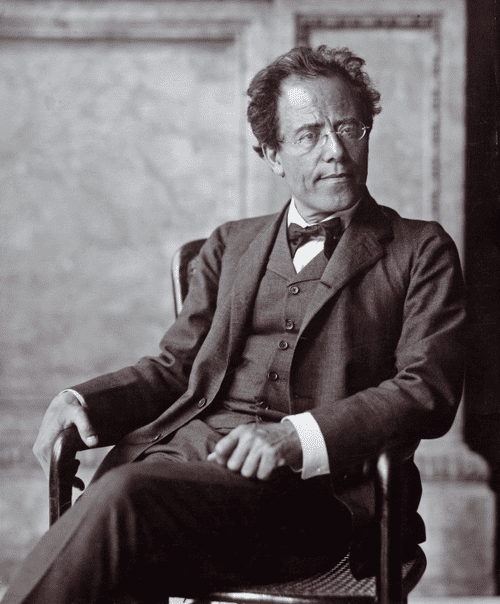
Let’s now turn to Mahler’s 8th Symphony, specifically the Second Movement. A little bit of historical context: Mahler’s 8th Symphony was the last released and performed in his lifetime. He conducted its premiere in Munich, Germany in 1910. He considered it the greatest of his works, writing in a letter from 1906, “I have just finished my Eighth—it is the greatest thing I have done thus far, and so strange in its form and content that it is impossible to write about it. Imagine that the universe begins to ring and resound, no longer with human voices but with revolving planets and suns.” Critics agreed, and the 8th was the first of Mahler’s symphonies to receive widespread acclaim. His other works have since been reappraised and given higher regard; conductor/composer Leonard Bernstein was a vocal proponent who brought the rest of Mahler’s oeuvre back into the public consciousness.
The first movement of the symphony is a resetting of a medieval Latin hymn, “Veni Creator Spiritus,” which creates a lovely synchronicity with Faust‘s medieval Book 1. (I say synchronicity because I can’t find any evidence the parallel was intentional.) It’s a worthy part of the symphony but apart from being of a medieval nature, it has nothing to do with Faust so we’ll set it aside.
While structurally very different from the first, the second movement of the symphony reuses many of the themes from the “Spiritus” hymn. Tonally, there are some important distinctions; the second movement loosely follows a traditional symphonic structure with an adagio, very ponderous and wholly instrumental, a scherzo where choral lines are reintroduced, and a finale to settle recurring themes and close things out. (This structure is contested, and it does seem at times to be more of a tone poem or cantata.) Narratively, the second movement closely matches the final scene of Faust. The long and mysterious opening/adagio played pizzicato by the strings, with subtle flourishes from the woodwinds, constructs the mountain scene. Eventually, a male chorus enters (the hermits) and sing in hushed tones of the sacred space:
Forests are swaying near,
Rocks press upon,
Roots cling to them,
Tree trunks move closer,
Wave on wave splash,
The deepest cave gives shelter;
Lions silently prowl,
Tame, surrounding us,
Honoring the sacred place,
Refuge of Love and Grace. (Standard English Translation)
Male soloists representing the three Paters arrive to sing variously of love, grace, and the divine. At length, we hear the heavenly angels from a children’s choir, and finally the Mater Gloriosa is announced by the penitent women, who plead for her to hear their supplications. Gretchen appears and sings:
Surrounded by a lofty choir of spirits, The newcomer is hardly aware of himself, He has no notion of the New Life, So, as yet, he becomes like the Holy Host. See, how he is set free From the old enfolding of earthly bonds. Out of ethereal garments The early force of youth appears! Allow me to instruct him, He is still dazzled by the New Day’s light.
Note here, again, that the female (Gretchen) becomes the teacher and guider of the male (Faust). We hear from the three named penitent women, and the choir of children sings continuously as heralds of the angel. The Mater Gloriosa proclaims: “Come! Elevate yourself to higher spheres! If he perceives you, he shall follow you.” The notation and musical direction here are upwardly oriented, mirroring the cartography and textual elements of the book.
To swelling strings and a magnificent chorus of (in some cases) 800 adult and child choir players, the chorus mysticus repeats the play’s final lines. As the chorus draws back, a triumphant horn section blows a mighty refrain of the “Creator Spiritus” motif, and with a rumbling organ foundation the symphony resolves on a resounding Eb major chord.
With Mahler’s own notes (“the universe begins to sing and resound”) and the definitive finale, it seems apparent that he wanted resolution and closure. Where Faust leaves us with ambiguity and unresolved conflicts – indeed, he extols the “messiness” of living – Mahler’s aim here seems to be the opposite. As I mentioned in my preamble to this discussion, there’s room for interpretation and arguably one could present the finale as a moment of transcendence, but not the final word on all things godly and profane. I would push back against that simply by presenting the composer’s own works. In his posthumous 9th symphony, significant tension and doubt are expressed through, for example, the adagio. His sixth symphony ends with fraught and devasting A minor chord that represents the fatal blow to the piece’s hero. Outside of the composer’s own works, it’s a general convention of music composition that a long, sustained major chord is employed to imply a satisfying closure, not to invite reflection on what may follow. In short, I think if Mahler wanted to imply ongoing tension he could have employed any number of design elements to do so. A slightly discordant cadence, a gradual decrescendo. Mahler also makes subtle changes to the dialogue in his own libretto, and these alterations downplay the element of instability.
Therefore, does the 8th Symphony accurately reset the literary Faust? I would say…well, no and yes. I think he replicates the basics of Goethe’s story and themes well enough, even transforms them into something far more rapturous in the heart than the words themselves can do. Yet the essence of Goethe’s novel is missing. Above all, he wanted us to understand how important it is that human beings never settle in one place for too long, that though struggle is often onerous and painful it’s the breakthrough moments of connection with something higher that define us. We cannot have those flashes of wild wonder and joy without the effort. I quite adore Mahler’s 8th, but it doesn’t hold up to hard scrutiny if examined as a counterpart to Faust. It’s better enjoyed as a transformation of the book, Mahler’s celebration of the divine feminine and the ever-present pull from above.
Readers, what do you think?
- “Eternal Feminine/Womanly”, Historical Dictionary of Nietzscheanism, 2nd ed. (Lanham, Maryland: The Scarecrow Press, 2007), p. 80. ↩︎

 Official Website of Jace Paul
Leave a comment