
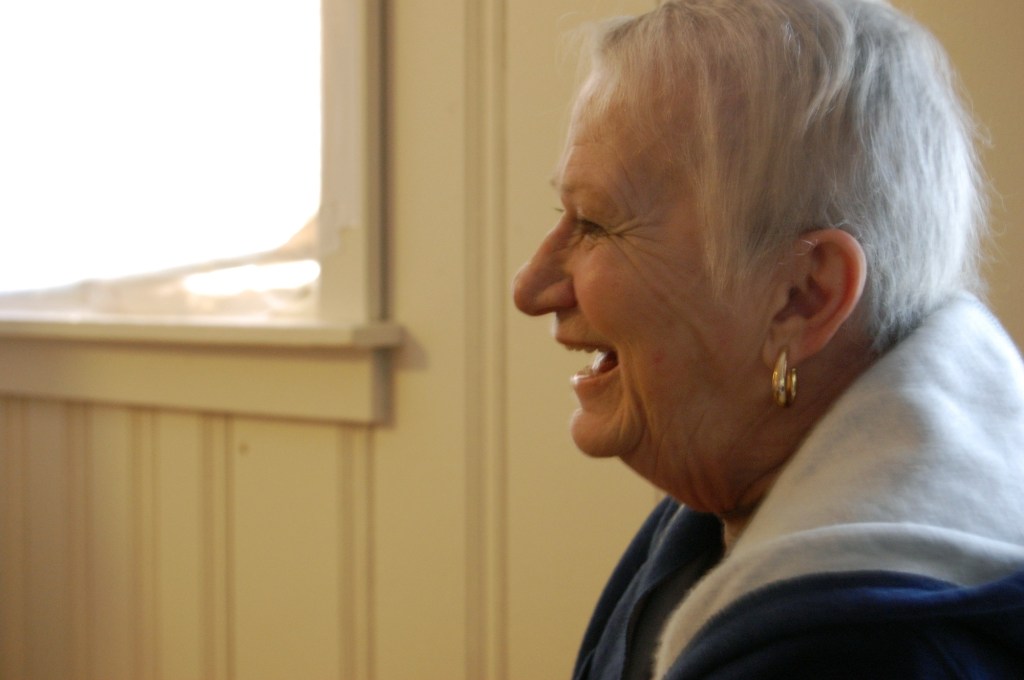
It is said by Buddhists that “Death is a lesson in the impermanence of all things.” When Barbara died, I immediately took stock of the many things that would no longer be: her outrageous laughter, a long-planned but never-executed trip to Canada, another July night eating pork fried rice at the Mansfield Drive-In Theater. She, once flesh and blood, became as all things do when their atoms fall apart – an abstraction. A ghost with infrequent and distant commentary on the forward arrow of time. The years, days, and hours are reduced to a novella of memories. We remember a conversation or two, or a particular feeling when presented with a familiar scent. How quickly the great tapestry of a life is brought to a pile of threads – precious, but paltry.
It must have been around 1986 that I first met Barbara, when I joined the Cub Scout Troop she led at the behest of my best friend (and her son) Bob. She was a recent divorcée, cast out of an artist’s life in Manhattan by a brutal separation that left her in residence on Millbrook Pond in Coventry, Connecticut. She quickly turned her three-story summer cottage on the waterside into a painter’s retreat. The walls sagged with canvases, gloriously stippled or else mesmerizing with motley involutions. The windows rattled with jazz, the modest rooms sickly with second-hand smoke. She made herself a patio with terracotta stone. She joined the local government and pissed off everyone in town. Her plainspoken manner rankled the farm-town aristocracy and blue-haired betties with soft spun morals.
At 11 or 12, I was nothing like her. A somber boy, I cowered from the constant abuse and mockery of my peers. I struggled with feelings of total worthlessness; my biological father had relinquished custody of me and disappeared into the White Mountains a year or two earlier. (He bought me an ice-cream cone and said “Well, it’s for the best. Good luck.”) I clung to anything rigid and unchanging for sanity; I was obsessed with order and orthodoxy. I was gris and melancholic. Barbara was a dancing star in my well-regulated universe, and at first it led to friction. When she allowed my friends and I to look at Playboy (and later view a soft-core flick on TV), I immediately reported it to my mother. Barbara, bless her, rolled her eyes and put up with my insecurity and, frankly, insufferable neurosis. She must have known: her wisdom would blossom within me in good time.
Necessity made the unlikely inevitable, as my alienation from in school worsened (I was now friends with an openly gay boy, which meant daily beatings and quotidian catcalls of “flamer” and “faggot”) and she lost custody of Bob. He was to live with his father in Stamford and visit every other weekend and during the summer. Bob was heartbroken, I was in need of a safe space, Barbara needed to nurture and teach – both were in her nature. Justin, the gay friend, needed to be loved unconditionally. Millbrook Pond became Shangri-la overnight as three misfit boys and one jilted painter made a makeshift island.
By my early teens I was spending most of my weekends and summers on the pond with Bob, Barbara, and Justin. Barbara taught us how to paint and made five-star meals on her meager artist’s budget. (Hot dogs with brie cheese on wheat toast? Surprisingly good.) She introduced us to films like “The Emerald Forest” and “Jesus Christ Superstar.” We made regular patronage at antique shops and rummage sales. We played games of Risk that lasted for three or four days.
It was her fondness for self-help and psychotherapy that would prove to be the most important contribution to my life. Through books on family dynamics and co-dependence, I slowly (and quite grudgingly) began to face my own psychological illness. Suddenly, as my sophomore year of high school began, the conversations we had acquired gravity. We would sit around her battered kitchen table long into the night discussing our emotional and spiritual dimensions. We talked about abuse and abandonment and what they did to mental health. (And, admittedly, we asked well-meaning but navel-gazing questions like: “Are there different parts of the soul?”) I began to understand why I suffered, and believe that someday I might not anymore.
High school continued to be awful to me, and I wondered how Barbara endured her banishment to the lowest rung of hillbilly hell. She was always forthright in her views – she had no trouble calling people out for being alcoholics or liars, or worse. But though she was often outraged by her surroundings, she quickly returned to humor for solace. We loved her uproarious cackle, so loud and wailing that it turned heads in any movie theater or restaurant we visited. She showed me that it was all right not to care about appearances one jot, and cultivate instead a lofty but crystal clear “I don’t give a single fuck” attitude toward anyone who dared to dismiss her.
In conversations with Bob and Justin, we have often spoken of Millbrook Pond as a “sanctuary.” There, we were free to roam the pine forest, walk the railroad tracks, or hike to the cemetery in the small hours of the morning. Barbara’s single greatest contribution to my life was providing a place without judgment or hatred for seven precious years. I’m not using hyperbole when I say that time and place, and her friendship at that time, saved my life.
How I loved riding in her Jeep Renegade with the doors removed, heading for the Peking House to pick up Chinese take-out and watch a movie. How I miss waking at dawn to the sound of bullfrogs on the pond. How I cherish the memories of our canoe sinking in snapping turtle waters, of camping in January under a steady falling of snow, of hiking the railway tracks from King’s Road to Depot Road, meeting Justin halfway. Being late home because we stopped to buy a suit of armor. My first time smoking pot. Cooking an Italian dinner with chicken and Ramen seasoning.
We grapple with the notion of mortality with such a strange and fluid vocabulary. Even now the memories of my time with Barbara grow dimmer; as I recount them less, like atrophying muscles, the stories shrink and attenuate. But I recall the feelings, the episodes measured in seconds, the way the light seemed to soak everything around the pond in gold.
My time with Barbara in the past decade was minimal. I did not know her well in her late years, though stories of her continued productivity as an artist reached me through intermittent communication with Bob. I visited her twice after I heard of her imminent passing, alone the first time and the second – at her request – with Bob and Justin, for one final reunion of old and kindred souls. We’ve all grown older and apart. I have seen Bob just a handful of times since we finished college; Justin and I were no longer friends after my divorce. But we needed this final meeting. As we looked over old photographs and picked out our favorite of her paintings to bring home, it felt like the right way to close the book on that chapter of our lives.
At that first meeting alone with Barbara, we got to talking about physics. Barbara was no believer in heaven or hell; but we reflected on what physics has to say about time and permanence. I mentioned the Holographic Principle in crude terms to match my cruder understanding, coming up with the conclusion: “Everything that has happened or will happen is generated by a “boundary” on the edge of the cosmos,” I said (and I hope that’s more or less accurate). We also reflected on the simple truth that everything that has happened can never have not happened. It seemed a comforting thing to both of us. We stared out the window of Calvary Hospital toward the Bronx and listened to the drone of her oxygen condenser. “So somewhere out there we’re all doing it over and over, then. The eternal Chinese take-out dinner.”
I miss it all: the unending discussion, the ramshackle cottage, the hot dogs on wheat toast. The cricket song dwindling in the crepuscular mist. Those irreplaceable years drown in the ineluctable flow of time; a frigid current without meaning except to pitiful three dimensional beings like us.
But there you are, Barbara, written on a boundary of light at the edge of the universe. And one day, I’ll join you there.

 Official Website of Jace Paul
Leave a comment